DIY Cables: braiding video essentials from the interwebs

If you’re into headphones and DIY, here’s a nice intro to DIY cables, the styles, and the math involved.

glassmonkey's avatarAudio Primate

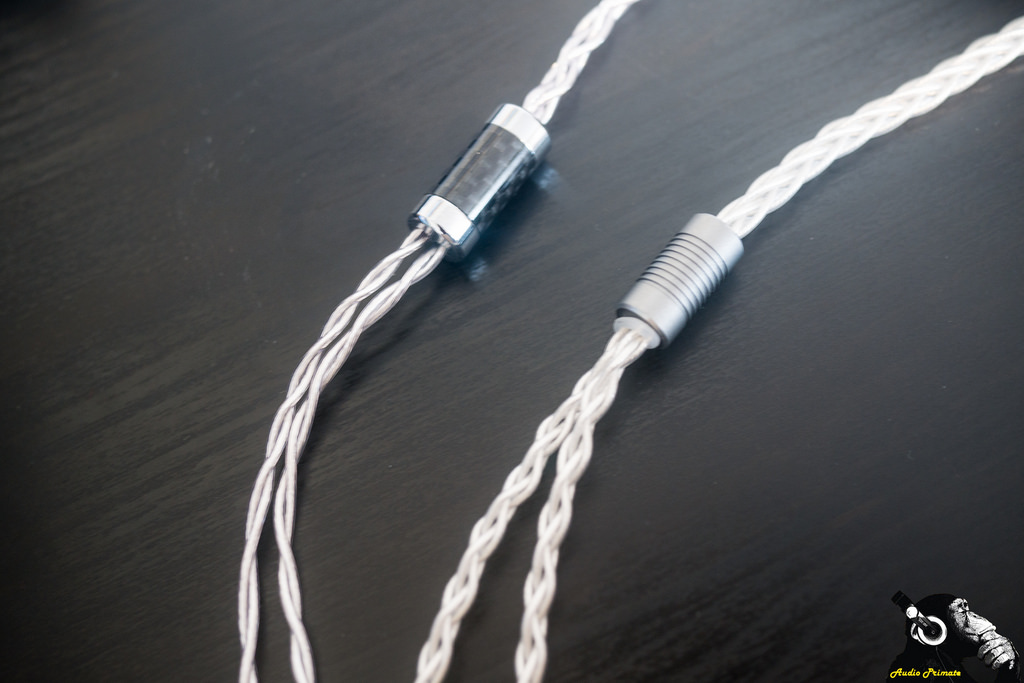
So if you’ve ever looked at aftermarket cables, you’ve probably seen about a million braids. The most common is the quad braid, usually seen in a round variety, but I do happen to own a flat braid quad cable that I bought in the UK. I’ve not made any of my own cables yet, but think it is about darn time I start. Honestly, I feel bad asking a friend to do it for me. It’s lazy, and unnecessary.

So for braiding, we should have a number of wires in multiples of 4. The reason is because this is what you’ll need to make a balanced cable. When you see cables that only have 2 wires and are balanced, it’s because the wires have multiple enamelled cores that they are splitting out, so essentially the wires are still working in multiples of 4. Even if you are going to use…

View original post 967 more words

Another Muchedumbre lives

I finished another Muchedumbre build with some slight variations.  This has two outputs and two inputs (easily switchable back to the 1+3 arrangement).  The power supply CLC filter uses all motor run caps instead of a mix of motor run and electrolytic. Other than these small tweaks, it is built as designed.

The wood apron is a very nice piece of walnut with a lot of prominent grain motion and color variation and the panel is inset rather than sitting on separate interior spacer boards. This is going to live a very happy life in Madison, WI.

WTF amplifier badges

logo plate white

Currently getting some quotes on badges for my builds.  I’ll be ordering extras if any other builders would like one to adorn their own DIY build!

Size standard is based on Neutrik D-series panel mount jacks.

I love kits, too

Especially when they are high quality kits.  Here are the contents of a TubeCAD Aikido kit that just arrived. John Broskie’s boards are top notch, the parts are bagged and labelled logically, and the included manual is excellent.  I’ll be building this kit up in a unique way (see TubeCAD’s article on the SRCFPP) and will post a build and my impressions in the coming weeks.

In the meantime, if you aren’t subscribed to and reading The TubeCAD Journal, you should be. Also consider contributing to John Broskie’s Patreon: for less than the cost of a Netflix subscription, you’ll support excellent vacuum tube DIY content and resources for everyone in the hobby.

USB interfaces for DIY audio measurements

USB interfaces

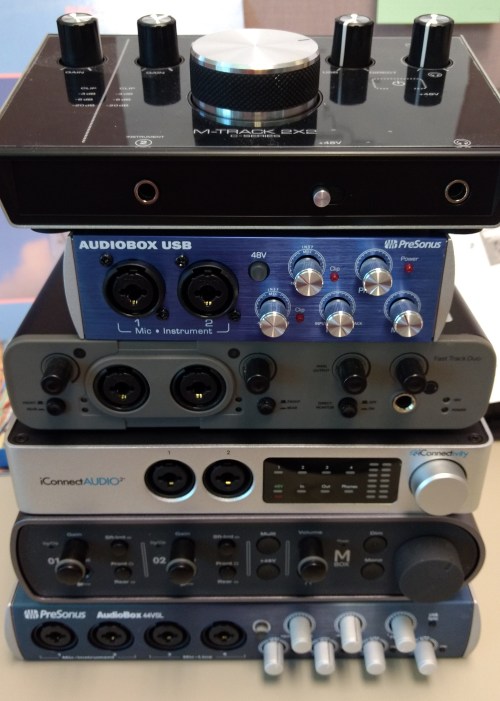
Looking for a better way to measure my line-level and amplifier projects, I decided to investigate some USB prosumer interfaces. Rather than options like the QA401 with its required software suite, the Keithley 2015 with uninspiring THD specs, or HP 8903 with a footprint and compatibility penalty, I wanted something small, flexible, and with performance good enough for tube audio. A USB audio interface will require voltage dividers for many measurements (whereas the lab equipment usually allows a higher Vrms input), but recording interfaces are inexpensive and flexible with software. Also, I don’t have the play money for an AP or dScope rig.

RMAA interfaces screenshot

These were all measured back to back on the same laptop with latest drivers and the same unbalanced cables. The same -1db level was used for all interfaces to get a relative distortion/noise baseline. RMAA doesn’t necessarily give an absolute and repeatable spec, but it is good enough for relative comparisons. All interfaces were measured several times; the displayed specs capture the “average” performance (calculated by eye).

  • The MBox 3rd Gen is an obvious winner in just about every regard. It was also a much more expensive interface when it was new.  MBoxes are no longer produced, but used interfaces aren’t difficult to find. This would be a decent basis for THD measurements of amplifiers (my intended use).
  • The M-Track 2×2 did rather well (as much as I hate to admit it) but doesn’t have two identical channels for this kind of thing (one TRS and one combo jack with mic pre). Wouldn’t recommend it for measurements for that reason.
  • The old Fast Track Duo (Avid branded bu made by M-Audio) blew chunks. Can’t rule out that my unit has some kind of issue.
  • The AudioBox USB looks good but there is a cross-talk issue. Possibly grounding with the unbalanced cables. The knobs are also too fiddly for fine adjustment in my opinion.
  • I really wanted the iConnectivity to perform the best here. In my opinion it’s the nicest piece of hardware. Unfortunately, the relative measurements don’t make it the best choice. It can be run from a 9V supply rather than the USB bus though and I may try that to see if there’s any improvement. No supply handy for this test.
  • The AudioBox 44VSL does pretty well (this is what I had been using for measurements). It also requires a 12V external supply and is a larger 4 mic pre interface, making it a little less convenient for a bench-top test setup. The 22VSL is smaller and may measure just as well (don’t have one to play with).

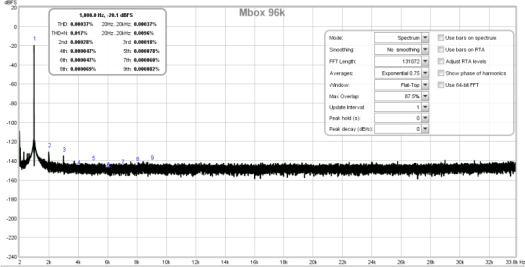
Here’s after some fine tuning the MBox levels in REW (sampling rate set to 96khz):

mbox-96k.png

This is close to the -110db THD Avid spec’d. All in all, I think I can live with the MBox for a while for my testing. Although all the caveats of RMAA and testing conditions/methodology apply, performance is on par with some specs I’ve seen on the cheaper audio analyzers and definitely a cut above the other USB interfaces here.

Link to RMAA software

Link to REW software

New 300B kit by Elekit (via diyaudio.com)

Note I have no affiliation with Elekit other than being an admirer of what they do for DIY audio hobbyists.

Elekit’s kits seem to hit attractive price points for what’s included (tubes, transformers, components, and a chassis) and the quality of the documentation. VK Music (Canadian importer of Elekit) just announced a new 300B amplifier on diyaudio.com here. Although details are sparse, we can maybe glean some ideas from the specs and the previous incarnation (Elekit TU-8300).

Specs for TU-8600:

• Tube Set : 12AU7 X 2 + 12AX7 X 1 + 300B X 2
• Now compatible with low to high impedance headphones
• Frequency response (-3dB) : 10Hz – 80kHz
• Max. output (THD 10%) : 8.3W + 8.3W (Input voltage : 250mV r.m.s)
• Residual noise : 42uV rms (IHF-A)
• Power consumption : 80W when no signal; 80W at max. output

The previous TU-8300 used MOSFET regulation for a B+ of 375V and because the new amp is rated for the same power, I think we can assume the new version operates at about the same voltage with a similar bias (-60V). Rather than two stages of 12AT7 on the input, the new design uses two 12AU7 and one 12AX7 triode per channel. So how are these arranged?

Let’s reverse engineer the numbers for an educated guess. We get full output of 8W from a -60V biased tube with an input of 250mVrms. If the 250mVrms (0.7V peak to peak) fully drives the output tube’s -60V bias (120V peak to peak), we have a gain of about 160x. That could be two successive stages of 12AU7, but then what is the 12AX7 doing? We appear to be using one half of the 12AX7 dual triode per channel. It would be an odd choice for a buffer stage, but it’s a plentiful tube and would make sense in that regard.

The other likely explanation is that we have some feedback at work and the 12AX7s are used for voltage gain. Maybe this is a grounded cathode 12AX7 into a 12AU7 SRPP. In terms of driving the Miller Capacitance of a 300B, this seems like a plausible arrangement. Gain would be in the 400-500x neighborhood, but feedback would knock this back down to the 160x overall and lower the output impedance.

Lastly, this amp includes a headphone output. Maybe the extra triodes are employed in some kind of follower specifically for the headphone section. A 12AU7 white cathode follower seems like a potential candidate. Whatever it is, I’ll be anxiously awaiting the manual and schematics to see what Mr. Fujita has come up with!

If you’re headed to the LA Audio Show (June 2nd-4th), the amp will be on display in the VK Music booth.

UPDATE 9/15/17: Here’s the first review I’ve seen, courtesy of Wall of Sound